
Five years ago, we asked whether the use of polyethylene glycol (PEG) in pharmaceuticals was a catch-22. PEGylation improves drug stability and half-life, but anti-PEG antibodies (APAs) can accelerate clearance and cause reactions. mRNA-LNP COVID-19 vaccines then exposed billions to PEGylated lipids, putting the question front and center.
In 2026, the evidence is more nuanced and more contested than either side predicted. This review summarizes 2024-2026 developments, weighing the growing-concern narrative against the skeptical counter-arguments.
Updated Prevalence: Higher, But Harder to Interpret
A 2026 Advanced Drug Delivery Reviews paper puts anti-PEG antibody prevalence above 70% in some adult populations, driven by environmental PEG exposure.[1] A Takeda-affiliated study detected PEG itself in 77.4% of healthy adults’ plasma.[2] But a Janssen (J&J) methodological study found 97.5% prevalence in 200 donors using ELISA — the authors themselves called this “surprising."[3] As Li et al. (2024) note, commercial anti-PEG ELISAs “differ significantly in terms of reagents and conditions."[4] Prevalence spanning 25% to 97.5% by assay is not a settled picture — a gap that’s both a research challenge and an opportunity for well-characterized, validated anti-PEG ELISA kits.
mRNA Vaccines Changed the Antibody Repertoire
The most significant 2024-2026 finding: mRNA-LNP vaccines didn’t just raise anti-PEG antibody levels — they changed the repertoire. Ju et al. found mRNA-1273 boosted anti-PEG IgG 13.1-fold and IgM 68.5-fold in 130 adults (BNT162b2’s effect was milder), correlating with reactogenicity — though neutralizing antibody responses were unaffected.[5] A Nature Reviews Immunology commentary flagged the open question of cross-reactivity with other PEGylated medicines.[6]
Building on this, a 2026 Semmelweis study (Facskó et al., Szebeni group) analyzed 325 plasma samples and found anti-PEG IgG gained progressively higher avidity toward larger, more complex PEG structures — effectively affinity maturation against a synthetic polymer — with vaccinated individuals (especially Spikevax recipients) showing broader cross-reactivity potential.[7] The authors recommend avidity-aware, not just titer-based, risk assessment. Limitations: cross-sectional design, no correlated clinical outcomes, and a SeroScience LLC-affiliated author roster (disclosed, no company role).
Clinical Significance: Plausible, Not Yet Documented
No documented case exists of vaccine-induced anti-PEG antibodies causing a confirmed adverse reaction to a PEGylated drug. The concern is theoretically plausible, circumstantially supported (FDA found anti-PEG antibodies from mRNA-1273 interfered with pegfilgrastim assays[8]), but not clinically documented.
The strongest clinical-harm evidence comes from outside vaccination: Khalil et al. found pre-existing anti-PEG IgG in 701 leukemia children reduced PEG-asparaginase activity and predicted hypersensitivity — but that’s environmental exposure in pediatric patients, not post-vaccine adults.[9] Separately, accelerated blood clearance (ABC) of PEGylated liposomes appears rare clinically: Zheng et al. found it in just 0.28% of 1,764 samples at DOXIL-relevant doses, and anti-PEG antibodies alone weren’t a reliable predictor.[10]
The Skeptical Counter-Narrative
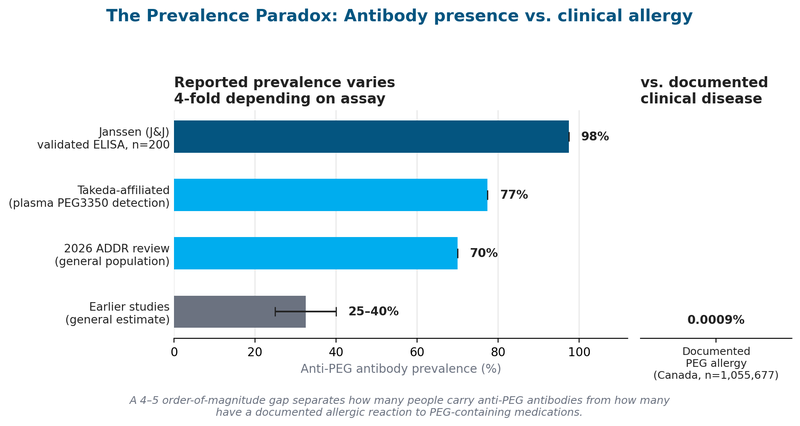
The Prevalence Paradox: antibody presence vs. documented clinical allergy. A 4-5 order-of-magnitude gap separates how many people carry anti-PEG antibodies from how many have a documented allergic reaction to PEG-containing medications.
The prevalence paradox: if 25-97.5% of people carry anti-PEG antibodies, why is documented PEG allergy vanishingly rare? A Canadian study of 1,055,677 patients found provider-documented PEG allergy in just 0.0009% (10 patients) — a 4-5 order-of-magnitude gap.[11]
FDA data against the IgE hypothesis: a joint FDA-CDC study found anti-PEG IgE was NOT associated with anaphylaxis case status — controls even had higher rates in the Moderna group.[12] A follow-on NIAID/FDA trial found only 2 of 16 prior reactors (12.5%) had recurrent reactions on revaccination; many “reactions” were psychogenic (ISRR), not true allergy.[13]
Long safety records exist: certolizumab pegol has over 21,000 patient-years of exposure with no immunogenicity safety signal.[14] And even Szebeni — often cited as the leading voice of concern — frames PEG as one contributing factor among several, not a sole cause, with severe mRNA-LNP adverse events “relatively rare (<0.5%)."[15][16]
PEG Alternatives: Real Innovation, Nothing Clinical Yet
Several genuinely novel 2025-2026 strategies: poly(D,L-serine) lipids (Nature Communications, minimal anti-pDLS IgM, patent filed)[17]; glycolipids replacing PEG-lipids (JACS 2025)[18]; randomized PEG backbones that disrupt the regularity antibodies recognize (JACS 2025)[19]; hydroxyl-terminated PEG, which evades pre-existing anti-PEG IgM by simply changing the end group (ACS Nano 2026, 1,970 samples screened)[20]; and sulfur ylide termini (JACS Au 2025).[21] Older concepts (POx, polysarcosine, low-PEG LNPs) continue seeing incremental data. The trend favors modifying PEG over replacing it — but no alternative has reached clinical trials as of 2026; PEG remains standard, with 30+ approved products and decades of safety data.
Detection: Advancing, Still Unstandardized
New tools include the first multiplexed isotyping assay for IgM/IgG/IgE[22], a portable 3D-printed SPR device[23], a validated bead-extraction method[24], and an optimized ELISA achieving >95% signal competition.[4] Despite this, the same sample can still yield very different results depending on kit — a gap that well-characterized anti-PEG ELISAs across species and isotypes, including mouse IgG and mouse IgM formats, aim to close.
Where This Leaves Us
The state of PEG immunogenicity in 2026: accumulating mechanistic concern, unresolved clinical significance.
| Question | Status |
|---|---|
| Are anti-PEG antibodies boosted by mRNA vaccines? | Confirmed (multiple studies) |
| Do they show altered binding behavior? | Confirmed (Semmelweis 2026) |
| Do they correlate with vaccine reactogenicity? | Confirmed (ACS Nano 2022) |
| Do they cause clinical harm to PEGylated drug recipients? | Not documented |
| Is anti-PEG IgE the mechanism for vaccine anaphylaxis? | Not supported (FDA/CDC data) |
| Are current assays reliable and standardized? | No — 4-fold variability in prevalence estimates |
| Are PEG alternatives reaching the clinic? | Not yet — all preclinical |
The practical takeaway: anti-PEG antibody monitoring remains prudent — not because harm is proven, but because the mechanism is credible, assays are fragmented, and mRNA vaccination has changed the population’s antibody repertoire. Screening for anti-PEG IgG and anti-PEG IgM before PEGylated-drug trials, and monitoring drug-specific ADA responses during them, remains the sensible approach while the field awaits definitive clinical evidence.
REFERENCES:
- Kiran R, et al. “Beyond PEG: Re-Engineering stealth-polymers to do more than just hide.” Adv Drug Deliv Rev. 2026;:115944. DOI: 10.1016/j.addr.2026.115944. PMID: 42580483.
- Kubesch K, et al. “Evaluation of Plasma Polyethylene Glycol (PEG) Levels in a Healthy Adult Population.” Int J Toxicol. 2025;44(6):451-457. DOI: 10.1177/10915818251371966. PMID: 40916574.
- Ehlinger C, et al. “A generic method for the detection of polyethylene glycol specific IgG and IgM antibodies in human serum.” J Immunol Methods. 2019;474:112669. DOI: 10.1016/j.jim.2019.112669. PMID: 31614128.
- Li Y, et al. “Optimized Enzyme-Linked Immunosorbent Assay for Anti-PEG Antibody Detection in Healthy Donors and Patients Treated with PEGylated Liposomal Doxorubicin.” Mol Pharm. 2024;21(6):3053-3060. DOI: 10.1021/acs.molpharmaceut.4c00278. PMID: 38743264.
- Ju Y, et al. “Anti-PEG Antibodies Boosted in Humans by SARS-CoV-2 Lipid Nanoparticle mRNA Vaccine.” ACS Nano. 2022;16(8):11769-11780. DOI: 10.1021/acsnano.2c04543. PMID: 35758934.
- Ju Y, et al. “Impact of anti-PEG antibodies induced by SARS-CoV-2 mRNA vaccines.” Nat Rev Immunol. 2023;23(3):135-136. DOI: 10.1038/s41577-022-00825-x. PMID: 36539526.
- Facskó R, et al. “Anti-PEG Immunogenicity of mRNA-LNP Vaccines in Humans: Evidence for Population-Level Changes in the Anti-PEG Antibody Repertoire.” Pharmaceutics. 2026;18(7):815. DOI: 10.3390/pharmaceutics18070815. PMID: 42514893.
- Svyatova EA, et al. “Anti-PEG Antibodies From mRNA COVID-19 Vaccines Affect In Vitro Measurements of Pegylated Drug Levels.” Clin Transl Sci. 2026;19(8):e70667. DOI: 10.1111/cts.70667. PMID: 42477513.
- Khalil A, et al. “Pre-existing anti-PEG antibodies are associated with reduced PEG-asparaginase activity at first exposure.” Haematologica. 2022;107(1):49-57. DOI: 10.3324/haematol.2020.258525. PMID: 33299233.
- Zheng Y, et al. “Revealing the Incidence of the Accelerated Blood Clearance Phenomenon of PEGylated Liposomes in Individuals Using a Drug-Release Reporter Liposome.” Small. 2025;21(34):e2500526. DOI: 10.1002/smll.202500526. PMID: 40552565.
- Abrams EM, et al. “Primary care provider-reported prevalence of vaccine and polyethylene glycol allergy in Canada.” Ann Allergy Asthma Immunol. 2021;127(4):446-450. DOI: 10.1016/j.anai.2021.05.011. PMID: 34004274.
- Zhou ZH, et al. “Evaluation of association of anti-PEG antibodies with anaphylaxis after mRNA COVID-19 vaccination.” Vaccine. 2023;41(28):4183-4189. DOI: 10.1016/j.vaccine.2023.05.029. PMID: 37244808.
- Khalid MB, et al. “A randomized double-blinded trial to assess recurrence of systemic allergic reactions following COVID-19 mRNA vaccination.” J Allergy Clin Immunol. 2024;153(6):1634-1646. DOI: 10.1016/j.jaci.2024.03.001. PMID: 38460680.
- Curtis JR, et al. “Long-term safety of certolizumab pegol…” RMD Open. 2019;5(1):e000942. DOI: 10.1136/rmdopen-2019-000942. PMID: 31245056.
- Neun BW, Barenholz Y, Szebeni J, Dobrovolskaia MA. “Understanding the Role of Anti-PEG Antibodies in the Complement Activation by Doxil in Vitro.” Molecules. 2018;23(7):1700. DOI: 10.3390/molecules23071700. PMID: 30002298.
- Szebeni J. “Reasons for and against PEGylation of mRNA-LNP Vaccines.” Pharmaceutics. 2025;17(10):1327. DOI: 10.3390/pharmaceutics17101327. PMID: 41155962.
- Zeng JY, et al. “Polypeptide-engineered lipid nanoparticles for mRNA delivery with limited immunogenicity.” Nat Commun. 2026;17(1):6986. DOI: 10.1038/s41467-026-73698-6. PMID: 42215480.
- Jin J, et al. “Glycolipids Substitute PEG lipids in Lipid Nanoparticles for mRNA Delivery.” J Am Chem Soc. 2025;147(45):41248-41255. DOI: 10.1021/jacs.5c16448. PMID: 41186003.
- Dreier P, et al. “Isomerization of Poly(ethylene glycol): A Strategy for the Evasion of Anti-PEG Antibody Recognition.” J Am Chem Soc. 2025;147(25):21538-21548. DOI: 10.1021/jacs.5c02716. PMID: 40512984.
- Ding T, et al. “Hydroxyl-Terminated Polyethylene Glycol Evades Human Pre-existing Anti-polyethylene Glycol Antibodies.” ACS Nano. 2026;20(24):17780-17794. DOI: 10.1021/acsnano.6c07672. PMID: 42261226.
- Sánchez-Cerrillo DM, et al. “Introducing Sulfur Ylides as Charge-Neutral Termini for Mitigating Poly(ethylene glycol) Antigenicity in Nanomedicine.” JACS Au. 2025;5(9):4378-4388. DOI: 10.1021/jacsau.5c00748. PMID: 41001646.
- Dyleski L, et al. “Development of a novel anti-PEG antibody assay enabling investigation of potential immunogenicity triggered by the PEG moiety of biotherapeutics.” J Immunol Methods. 2025;543:113917. DOI: 10.1016/j.jim.2025.113917. PMID: 40738327.
- Pasquardini L, et al. “Development of a portable device for the detection of anti-PEG antibodies in human plasma.” Sci Rep. 2026. DOI: 10.1038/s41598-026-58122-9. PMID: 42315884.
- Williams WT, et al. “Development of a validated novel bead extraction method for the detection of anti-PEG antibodies in human serum.” Bioanalysis. 2025;17(1):7-15. DOI: 10.1080/17576180.2024.2442198. PMID: 39696894.