
Human DAO (diamine oxidase) ELISA Kit | EL-213-04
Cat. No: EL-213-04
$859.99 USD
96 wells
| Target protein | DAO (diamine oxidase) |
|---|---|
| Alternative name | AOC1; amine oxidase, copper containing 1; histaminase |
| Gene ID | 26 |
| Reactivity | Human |
| Detection range | 3.13-200 ng/mL |
| Sample type | serum, plasma, tissue homogenates and other biological fluids |
| Sample volume | 100 µL |
| Assay time | 3h 20min |
| Precision | Intra-assay CV <8%. Inter-assay CV <10% |
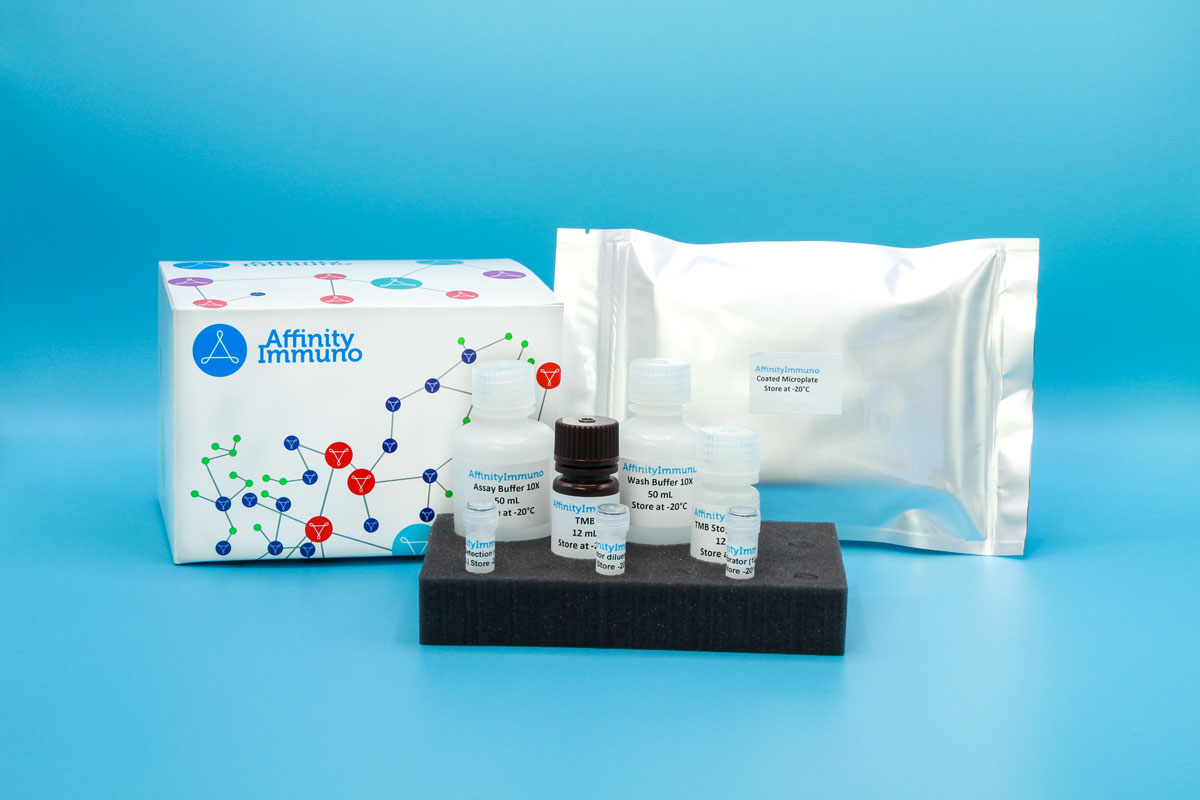
| Components | Pre-Coated Microplate - 12 strips x 8 wells (4°C/-20°C) Standard (Lyophilized) - 2 vials (4°C/-20°C) Biotinylated Antibody (100×) - 120 μL (4°C/-20°C) Streptavidin-HRP (100×) - 120 μL (4°C/-20°C) Standard/Sample Diluent Buffer - 20 mL (4°C/-20°C) Biotinylated Antibody Diluent - 12 mL (4°C/-20°C) HRP Diluent - 12 mL (4°C/-20°C) Wash Buffer (25×) - 20 mL (4°C/-20°C) TMB Substrate Solution - 10 mL (4°C/-20°C (store in dark)) Stop Reagent - 6 mL (4°C/-20°C) Plate Covers - 2 pieces (RT) |
| Storage | 4°C/-20°C |
Introduction
Diamine oxidase (DAO) is a copper-containing enzyme, historically also called histaminase, that oxidatively deaminates histamine and related biogenic amines such as putrescine, cadaverine, and spermidine. Its official HGNC gene symbol is AOC1 (amine oxidase, copper containing 1, NCBI Gene ID 26); the symbol “DAO” is formally reserved for a separate, unrelated gene, D-amino-acid oxidase, a peroxisomal flavoenzyme that acts on D-amino acids rather than histamine. The enzyme measured by this kit – and referred to throughout as DAO in keeping with the kit’s own common naming – is the AOC1 gene product, not the D-amino-acid oxidase gene product. AOC1/DAO is expressed mainly in the intestinal mucosa and placenta, with additional expression in kidney and eosinophils, and inactivates histamine by converting it to imidazole-4-acetaldehyde while generating hydrogen peroxide and ammonia. Reduced AOC1/DAO activity has been associated with histamine intolerance, and diminished placental AOC1/DAO activity has been studied in connection with early-onset preeclampsia, making circulating DAO measurement relevant to both nutrition-related research and reproductive health research.
Because reduced DAO/AOC1 activity is associated with histamine intolerance and diminished placental activity has been studied in early-onset preeclampsia, this assay serves both nutrition/food-intolerance research and reproductive-health research — two distinct audiences worth calling out explicitly given how often the DAO name is confused with the unrelated D-amino-acid oxidase gene.
Principle of the Assay
This kit uses a sandwich enzyme immunoassay format in which the microtiter plate wells are pre-coated with a capture antibody specific to human DAO. Standards or samples are introduced into the appropriate wells alongside a biotin-conjugated detection antibody that also targets human DAO. Avidin conjugated to horseradish peroxidase (HRP) is then added to each well and allowed to incubate, linking enzymatic activity to any captured analyte complex. Upon addition of TMB substrate solution, a colorimetric signal develops exclusively in wells containing human DAO, the biotin-conjugated antibody, and avidin-HRP. The enzymatic reaction is stopped by the addition of sulphuric acid solution, and the resulting color change is measured spectrophotometrically at 450 nm (± 10 nm). Sample concentrations are determined by comparing the optical density of each sample against a standard curve.